There is a fundamental mismatch at the heart of AI-based manufacturing quality inspection. The entire business case for AI inspection is that defects are caught before they escape — but the entire business case for running a good factory is that defects are rare. A well-run production line might produce a critical defect once in every five hundred to a thousand parts. That means a manufacturer waiting to collect training data is waiting for things to go wrong, then waiting for them to go wrong again, dozens or hundreds of times, before they have enough examples to train a model.
Generative AI breaks this constraint entirely. Instead of collecting defect images from production, you simulate them — with fine-grained control over location, severity, geometry, and surface characteristics. From as few as 3 real defect samples, a generative AI system like FleX-Gen can produce a training dataset large and varied enough to build a production-grade AI inspection model. This article explains how that works, what it takes to make synthetic data trustworthy, and where it genuinely expands what’s possible for manufacturers deploying AI inspection on the factory floor.
Key Takeaways
- Rather than merely synthesizing defects, generative AI creates new data based on learned defect features and user-defined descriptions, effectively replacing or augmenting real training sets to eliminate lengthy data collection phases.
- Synthetic data must pass realism validation before being used for training — quality control on generated images is as important as quality control on real inspection data.
- FleX-Gen achieves up to 10× improvement in False Acceptance (FA) rate and reduces defect image collection time by 3–8×, based on deployed customer cases.
Why Data Scarcity Is the Real Deployment Bottleneck
When manufacturers evaluate AI visual inspection systems and ask why deployments take months rather than weeks, the answer is almost never about hardware installation or software integration. It’s about data—specifically, collecting, labeling, and validating enough defect images to train a model that performs reliably at the accuracy thresholds production requires.
A 2025 industry analysis published by Dataspan found that while 72% of manufacturers are already using AI vision systems for inspection, widespread adoption has not translated into mature deployment — because many systems still struggle with accuracy and reliability rooted directly in data scarcity. The problem is structural: defects are rare by design in well-run facilities, and the harder a team works to eliminate defects, the smaller their training dataset becomes.
Three specific scenarios make this bottleneck severe enough to regularly stalls projects:
New Part Launches
When a new part enters production — especially in automotive or electronics — there is no historical defect dataset to draw from. The AI model needs to be ready before, or immediately after, production begins. Waiting for production to generate defect examples takes months. Generative AI compresses this timeline to days: from a small number of intentionally damaged samples orsimulations, a complete training dataset can be built before volume production starts.
Rare but Critical Defect Types
Some defects are structurally rare — a weld crack in a structural automotive component, a dendrite formation in a battery cell, or a void in a semiconductor die attach. These may appear once in tens of thousands of parts. They are also exactly the defects where a single escape can cause the most damage: safety incidents, OEM quality deratings, or product recalls. Conventional AI training cannot learn from 1–3 real examples. Generative AI can synthesize hundreds of realistic variants of these defects, giving the model enough exposure to detect them reliably.
High-Mix Production
A Tier 1 supplier running 40+ part numbers doesn’t have defect history for each one. With each new model year, parts change. Generative AI enables teams to build new defect models for every part variation without waiting for that part to fail in production.
The Generative Architectures Behind Synthetic Defect Data
Two AI architectures dominate synthetic defect generation for manufacturing: Generative Adversarial Networks (GANs) and diffusion models. Understanding how they differ helps clarify where each is most useful.
GANs: Speed and Controllability
A GAN consists of two competing neural networks: a generator that produces synthetic images and a discriminator that attempts to distinguish them from real images. Through adversarial training, the generator learns to produce outputs the discriminator cannot reliably identify as synthetic. A comprehensive review published in the Journal of Intelligent Manufacturing documented GAN applications across aerospace (DCGAN for composite fiber inspection), semiconductors (WAE-based defect detection for wafer maps), and metal surface inspection — establishing that well-trained GANs can match real-data model performance in controlled scenarios. The primary advantages of GANs for manufacturing are training speed and explicit control: the generator can be conditioned to produce defects of specified size, position, and morphology.
Diffusion Models: Fidelity and Texture Realism
Diffusion models take a different approach — starting from random noise and iteratively denoising toward a target image distribution. Research published in Anomaly Detection for Industrial Applications (Taylor & Francis, 2025) found that diffusion models excel at generating complex textures and surface patterns compared to GANs, making them better suited for defects where texture characteristics at the defect-surface interface matter — such as corrosion patterns, micro-crack propagation in metals, and coating delamination. The trade-off is computational cost: diffusion models are slower to train and generate, although inference pipelines have become substantially faster as the architecture has matured.
FleX-Gen’s architecture draws from both paradigms — using generative techniques optimized for the speed and controllability requirements of factory deployments, where an engineer needs to generate a training dataset in hours, not days.
How FleX-Gen Generates Synthetic Defects: The Technical Pipeline
The process from a real defect sample to production-ready training dataset involves several precisely controlled steps. Understanding each step helps clarify why synthetic data quality is not automatic — it’s the result of deliberate engineering choices.
Step 1: Anchor on Real Samples
FleX-Gen starts from as few as 1 real defect image. These anchors capture the surface texture, defect morphology, and imaging characteristics (lighting signature, depth profile) of the actual defect type as it appears in production. The generator does not operate from abstract descriptions — it learns from real examples. This is what distinguishes industrial-grade synthetic data from purely simulated imagery that lacks the visual characteristics of real manufacturing surfaces.
Step 2: Parameterized Generation with Controllable Variation
Once the generative model is seeded, engineers can control the output along multiple axes: defect position (where on the part surface), size (spanning the acceptable-to-critical severity range), orientation, and background surface texture. This controllability allows the resulting dataset to represent the full morphological range of a defect type — not just the 3 specific instances that happened to appear in production.
Step 3: Realism Validation
Generated images are not automatically trustworthy. An unrealistic synthetic defect — one that looks subtly different from real production defects — can actively mislead the downstream model, causing it to learn features that don’t generalize to real inspection conditions. Effective synthetic data pipelines include structural similarity validation, visual quality filtering, and, where possible, human expert review of generated samples before they enter the training set. Research from the International Journal of Advanced Manufacturing Technology (2025) demonstrates that synthetic 3D surface defect datasets must be validated through direct geometric comparison with real scanned surfaces to confirm that key defect characteristics are preserved.
Step 4: Mixed Dataset Training
The optimal training approach in most FleX-Gen deployments is not a fully synthetic dataset, but a mixed one — real defect samples combined with synthetic augmentations. The real samples anchor the model to actual production characteristics; the synthetic samples extend coverage across the morphological range and fill gaps for rare defect types. This hybrid approach consistently outperforms either pure-real or pure-synthetic training in production accuracy benchmarks.
What Synthetic Data Actually Changes in Deployment Timelines
The business impact of generative AI in inspection is ultimately measured in time: how much faster a manufacturer reach production-grade AI accuracy with FleX-Gen than without it?
| Deployment Phase | Without Synthetic Data | With FleX-Gen |
| Initial defect data collection | 2–6 months (waiting for production defects) | Days (3 samples sufficient to start generation) |
| Coverage of rare defect classes | Incomplete — rare defects may not appear during data collection window | Full — synthetic generation covers rare morphologies |
| Model accuracy at launch | Lower — limited defect class coverage | Higher — broader morphological range represented |
| New part onboarding | Requires new production defect collection cycle | Model ready before volume production begins |
| False Acceptance (FA) rate improvement | Baseline performance | Up to 10× improvement (per FleX-Gen customer case data) |
Customer data from UnitX FleX-Gen deployments shows defect image collection time reduced by 3–8× and FA rates improving by up to 10× compared to the same model trained on real data alone. The FA improvement is particularly significant: because synthetic generation covers the full morphological range of a defect type, the model is less likely to miss unusual-looking instances of a known defect class — exactly the cases that create dangerous escapes in production.
Learn more about how UnitX’s CorteX AI platform integrates with FleX-Gen for end-to-end model training and deployment.
The Quality Control Problem: Not All Synthetic Data Is Equal
The most important thing practitioners need to understand about synthetic defect data is that its value depends entirely on its realism. A generative model that produces visually plausible but physically unrealistic defects —such as incorrect texture-to-depth relationships, inaccurate surface reflectance under a specific imaging system’s lighting, or improper defect boundary geometry — will generate training data that misleads rather than informs.
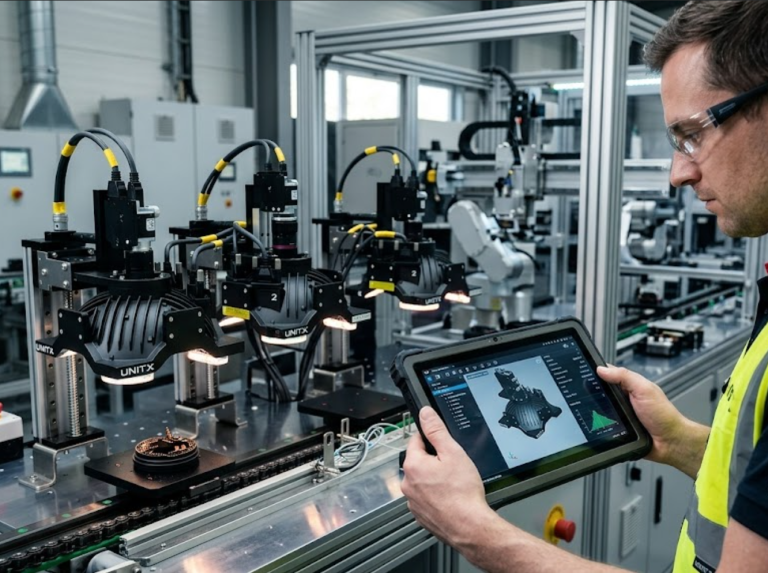
This is why FleX-Gen is designed to operate in close integration with OptiX imaging. Synthetic defect images are generated to match the imaging characteristics — lighting spectrum, 2.5D depth profile, and surface reflectance — of the actual OptiX hardware used in production. A scratch generated for training looks the way a scratch appears under OptiX’s software-defined illumination, not how it appears in a generic RGB photograph. This domain alignment between the synthetic data and the real imaging system is what enables FleX-Gen trained models to transfer reliably to production conditions.
The UnitX Applications Engineering team applies additional validation protocols during FleX-Gen deployments: generated samples are reviewed against real production images, structural similarity metrics are evaluated, and borderline generated images are filtered before the dataset is finalized. This level of synthetic data quality control is not optional — it’s what separates deployed AI inspection systems that achieve near-zero false acceptance from those that perform well in benchmarks but under-deliver in production.
FleX-Gen in Practice: EV Battery and Semiconductor Use Cases
Two industries where synthetic defect data has a particular strong impact are EV battery manufacturing and semiconductor packaging — both characterized by rare but high-consequence defects.
EV Battery: Dendrite and Micro-Short Detection
Battery dendrite formation — the microscopic metallic filament growth that can cause internal short circuits and thermal runaway — is one of the hardest defects to collect training data for. By definition, a battery with visible dendrite formation has already failed. Available samples are limited, fragile, and difficult to photograph consistently. FleX-Gen enables battery manufacturers to generate a library of synthetic dendrite images at various growth stages, across cell formats, and under different imaging conditions — building model coverage for a defect type that would otherwise have fewer than 10 real training examples. Visit the UnitX battery inspection page for more context on AI inspection in EV battery manufacturing.
Semiconductor: Wafer Surface and Die Attach
In semiconductor manufacturing, defect types vary by process node, material stack, and equipment condition — and new defect signatures emerge continuously as fabs push toward smaller geometries. NVIDIA’s technical documentation on semiconductor inspection notes that achieving high accuracy in this domain has traditionally required thousands of labeled images per defect class, with rare or emerging defects frequently lacking sufficient examples. FleX-Gen’s ability to generate new defect morphologies from minimal real samples addresses this constraint directly, enabling inspection models to stay current with evolving process conditions without requiring months of defect collection after each process change.
Frequently Asked Questions
Can synthetic defect data fully replace real training data?
In some scenarios, yes — FleX-Gen can generate training datasets that fully replace real defect data, and UnitX has deployed models trained entirely on synthetic data for specific defect types where real samples are extremely rare. In most production deployments, the optimal approach is a mixed dataset: real samples as anchors, with synthetic data extending coverage and volume. The key validation requirement is that synthetic samples pass realism checks against the actual imaging system before being incorporated into training.
How many real samples does FleX-Gen require to start generating?
FleX-Gen’s generative model can be seeded from as few as one real defect image. Generated outputs are more varied and reliable with additional anchor samples — 5 to 10 real examples is a practical sweet spot, that gives the generator enough morphological context while remaining achievable early in a new part’s production lifecycle.
Does using synthetic data create regulatory compliance issues?
This depends on the industry and the specific regulatory framework. For most manufacturing inspection applications — automotive, electronics, and general industrial — synthetic training data raises no inherent compliance concerns, provided the resulting model is validated against real production data before deployment and that validation data is properly documented. For regulated industries like medical devices, consult your quality management team and explicitly document the synthetic data generation and validation methodology in the model development record.
How does FleX-Gen handle surface texture variation across product batches?
Batch-to-batch material variation — a common source of model drift in AI inspection — is addressed in FleX-Gen by generating training samples across the range of surface textures and material characteristics the inspection system will encounter. When a new material batch introduces surface characteristics outside the training distribution, FleX-Gen can generate additional synthetic samples representing the new surface context and retrain the model rapidly — typically within the same production shift.
Explore UnitX FleX-Gen — generative AI for defect data — or talk to UnitX experts to see how synthetic defect generation accelerates inspection model deployment for your production environment.