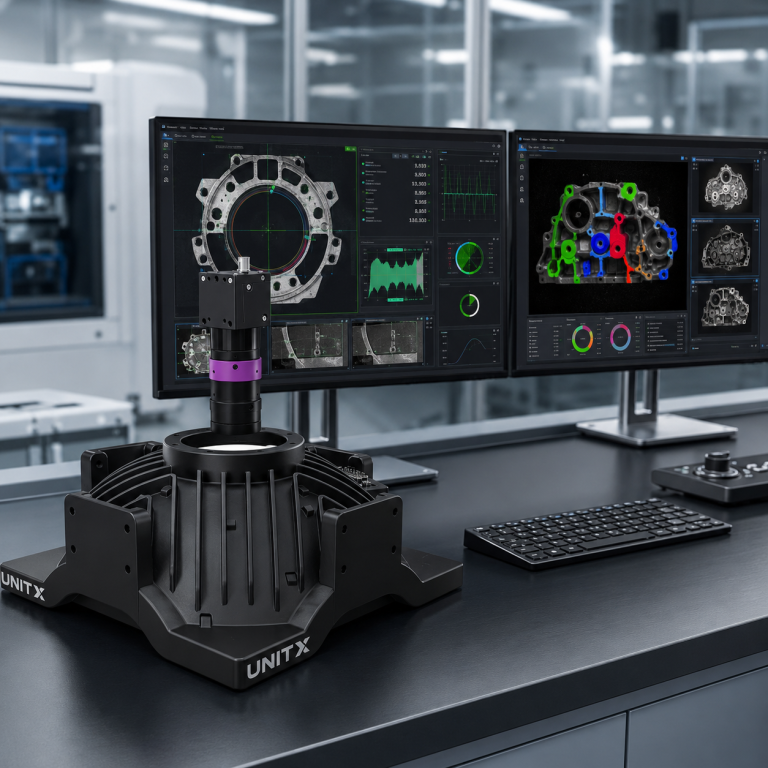
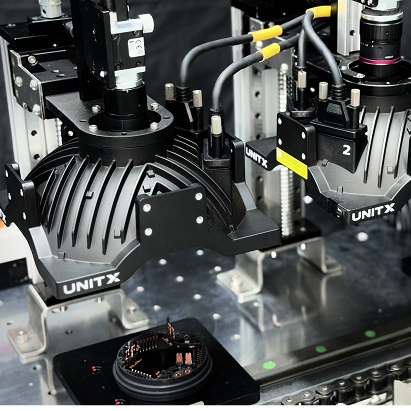
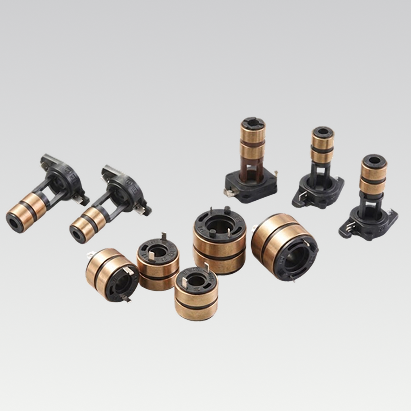
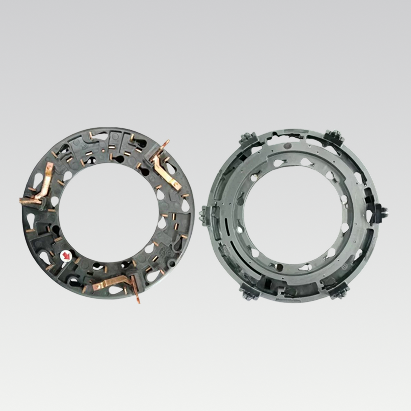
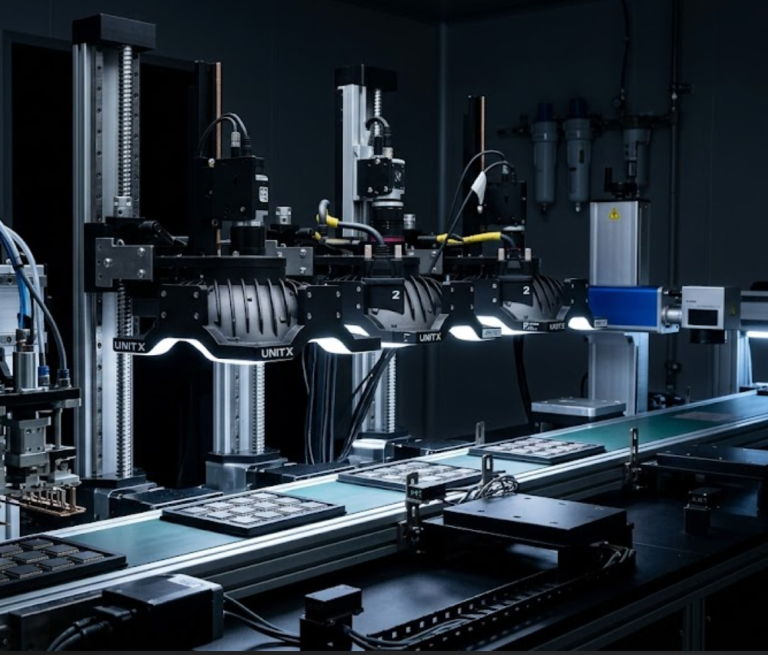
Automotive manufacturers now operate under a quality regime that legacy inspection methods were never designed to meet. A peer-reviewed survey of more than fifty AI inspection studies, published in early 2025, found that machine learning-powered vision achieves defect detection accuracy above 95% in live production environments, with some configurations reaching 98% to 100%. Meanwhile, 77% of AI vision implementations remain at the prototype or pilot scale — a gap that represents both a competitive risk and a significant opportunity for quality engineers who move first.
The stakes are concrete. The global automotive AI quality inspection market was valued at $465.3 million in 2024 and is projected to reach $2.64 billion by 2034, growing at a 19.6% CAGR — a trajectory that reflects how rapidly Tier-1 suppliers and OEMs are moving from pilot to full production deployment. This guide compares eight of the most important AI-powered defect detection capabilities for automotive manufacturing, evaluates what differentiates them at scale, and provides a practical framework for quality engineering teams selecting systems for stamping, welding, paint, and final assembly operations.
Key Takeaways
- AI defect detection achieves 95%–99% accuracy at 10,000+ parts per hour — compared to approximately 80% accuracy for manual inspection, which degrades further over long shifts.
- Sample efficiency is the most underrated selection criterion: systems that can train effective models from 5 labeled images per defect class can be deployed in days, while systems requiring 500–5,000 images take months.
- Edge-first architecture is non-negotiable for production-line inference — cloud-dependent systems introduce latency that disrupts high-speed inspection timing requirements.
- Integration with MES and closed-loop quality control is the difference between defect detection and defect prevention — the same data that triggers reject decisions should also feed process adjustments.
- ROI timelines of less than 12 months are achievable for automotive Tier-1 suppliers in high-variation defect applications when system selection aligns with production realities.
The Automotive Quality Challenge That Legacy Inspection Cannot Solve
Why Manual Inspection Fails Modern Automotive Lines
At a high-end automotive OEM facility, a finished vehicle rolls off the line every 57 seconds — and it might be a combustion-engine, plug-in hybrid, or fully electric variant drawn from thousands of distinct customer configurations. No manual inspection regime can maintain consistent defect detection accuracy across that level of variant complexity at that throughput rate. AI tools, including artificial neural networks and deep learning, have significantly improved prediction and defect identification capabilities in automotive manufacturing precisely because they scale with variant complexity in ways that human visual systems cannot.
The inspection gap is quantifiable. Manual inspection allows approximately 15%–20% of surface defects to escape detection, and accuracy degrades measurably after six hours of repetitive visual inspection tasks. AI-powered in-line inspection systems do not experience attention drift, shift-to-shift variability, or lighting sensitivity — they maintain identical detection performance across every shift, every part, and every configuration change.
The economic consequences of defect escapes in automotive manufacturing are severe: warranty claims, OEM penalty fees, truckload-scale rework, and brand damage that compounds over model years. UnitX automotive inspection deployments document up to a × reduction in defect escapes compared to manual or rule-based inspection baselines, with approximately $1.3M in annual ROI per production line for automotive Tier-1 applications (UnitX customer data).
The Shift from Rule-Based to AI-Powered Detection
Traditional rule-based machine vision systems require engineers to manually define detection thresholds for every defect type: “if pixel variance in region X exceeds threshold Y, reject.” This approach breaks down under three core challenges in automotive manufacturing: surface variation across part batches, new defect types that were not anticipated during setup, and the combinatorial complexity of mixed-model production. Defining rules for a complex stamped panel application can require weeks of engineering time, And updating those rules when a new defect class appears often means restarting the process.
AI-powered detection inverts this paradigm. Instead of defining rules, engineers provide labeled defect examples, and the model learns to generalize detection criteria from those examples. The critical differentiator is how efficiently a given system learns from limited data — a major bottleneck in automotive manufacturing, where defects are intentionally rare and labeled samples are therefore scarce.
8 Critical AI Defect Detection Capabilities for Automotive Manufacturing
1. Surface Defect Detection — Scratch, Dent, and Coating Anomaly Classification
Surface defects on stamped panels, painted body-in-white components, and precision-machined powertrain parts represent the highest-volume inspection category in automotive manufacturing. AI detection systems classify sub-millimeter scratches, dents, contamination, and coating anomalies at production speed — reliably catching defect classes that human inspectors miss under factory lighting conditions.
The key technical requirement is pixel-level segmentation precision. Systems that produce bounding box outputs rather than pixel-level classification provide insufficient spatial resolution for body panel inspection, where defect boundaries matter for repair-or-reject decisions. The UnitX AI visual inspection system implements deep learning segmentation for pixel-precise defect classification — distinguishing between a reparable micro-scratch and a reject-level gouge on the same surface within a single inference pass.
2. Weld Quality Inspection — Porosity, Crack, and Incomplete Fusion Detection
Body-in-white and battery pack assembly rely extensively on laser and resistance welding, and weld quality defects — porosity, hot cracking, cold laps, and incomplete fusion — are among the most safety-critical defect classes in automotive production. AI inspection systems trained on weld image libraries detect these features at line speed without the throughput penalties of offline X-ray inspection.
Battery tab laser weld inspection is a particularly high-stakes application as EV production scales. AI-powered battery tab weld inspection detects weld geometry deviations, spatter contamination, and fusion discontinuities that can create thermal runaway risks in deployed battery packs — defects that visual inspection cannot reliably detect at production throughput.
3. Dimensional and Geometric Measurement — Sub-Pixel Accuracy at Line Speed
Stamped metal components, connector assemblies, and powertrain components require dimensional verification against tight tolerance specifications. AI-powered vision systems replace coordinate measuring machine (CMM) spot-checks with 100% in-line dimensional gauging, detecting burrs, missing material, deformation, and out-of-tolerance dimensions at production throughput.
The measurement requirement for automotive-grade dimensional inspection is sub-pixel accuracy, typically 0.1–0.3 mm detection at 50 MP imaging resolution. This demands imaging systems with sufficient physical resolution to capture dimensional features and AI inference architectures that report measurement values rather than simple pass/fail outputs. Integration with SPC (statistical process control) systems allows dimensional data to drive process adjustments before out-of-tolerance conditions accumulate.
4. Assembly Verification — Component Presence, Position, and Orientation
Final assembly operations in automotive manufacturing require confirmation that every fastener is present and torqued, every clip is engaged, every harness connector is seated, and every component is correctly oriented before the vehicle moves to the next station. AI vision systems inspect these conditions at line speed, replacing manual 100% checks that are impractical at modern production rates.
Assembly verification differs from defect detection in its tolerance for semantic flexibility — the system must recognize a correctly assembled configuration across legitimate part variation while flagging true absences and misplacements. AI systems trained on production data generalize across model variants automatically; rule-based systems require manual reprogramming for each new assembly configuration.
5. Paint and Coating Inspection — Runs, Fisheyes, and Orange Peel
Paint application quality on body panels is one of the most demanding inspection challenges in automotive manufacturing. Defect classes include orange peel texture, fisheye contamination, paint runs and sags, color variation, and metallic flake distribution irregularities — all of which require specific illumination geometry and contrast conditions to be reliably detected. AI systems trained on paint defect datasets achieve consistent detection across color variants and panel geometries that often defeat rule-based approaches.
The illumination challenge makes software-defined lighting particularly valuable. A scratch that appears clearly under dark-field illumination may be invisible under bright-field, while a paint run that is visible under bright-field may be missed under dark-field. OptiX’s 32-channel software-defined lighting captures multiple illumination perspectives in a single part transit, providing AI models with the multi-angle input needed for comprehensive paint defect coverage.
6. Sample-Efficient Model Training — From 5 Images to Production Accuracy
In automotive manufacturing, defects are intentionally rare — a well-controlled production line may produce defective parts at rates as low as 50–200 PPM (parts per million). This creates a fundamental training data challenge: how do you train an AI inspection model with only 5–20 real defect examples? The answer determines whether a new inspection application takes days or months to deploy.
Systems that require 500–5,000 labeled images per defect class are impractical for automotive applications with rare defect types. FleX-Gen addresses this by generating synthetic defect images from as few as 3 real defect samples — creating the dataset volume needed for effective training without waiting months for production defects to accumulate. As a result, model training can be completed in approximately 30 minutes, compressing deployment timelines from months to days (UnitX customer data).
7. Multi-Task Detection — Simultaneous Classification Across Defect Categories
A single automotive inspection station may need to verify dimensional tolerances, detect surface defects, confirm assembly completion, and read part identification codes simultaneously. Systems that require separate inference passes for each task introduce cycle time bottlenecks; AI platforms that support multi-task detection in a single pass preserve line throughput.
CorteX supports 8 detection task types within a single inference architecture — detection, classification, counting, threshold, localization, measurement, depth estimation, and barcode reading. This capability is particularly valuable for end-of-line inspection stations, that serve as the final quality gate before shipping, where comprehensive coverage across all defect and verification categories must complete within the available cycle time.
8. Closed-Loop MES Integration — From Detection to Process Adjustment
The most mature AI inspection implementations do not stop at defect detection — they feed inspection data back into manufacturing execution systems (MES) to drive process correction before defects accumulate. The strategic shift is from reactive containment to predictive assurance: AI inspection data feeds digital twin models that predict defect occurrence before physical manifestation, enabling maintenance scheduling and process adjustment before yield loss occurs.
MES integration with PLC-level reject signaling forms the operational foundation; closed-loop quality control that drives process parameter adjustments is the true competitive differentiator. UnitX solutions integrate directly with customer MES systems for real-time data traceability and closed-loop quality control, enabling quality engineers to use inspection data for process intelligence rather than simply generating reject counts.
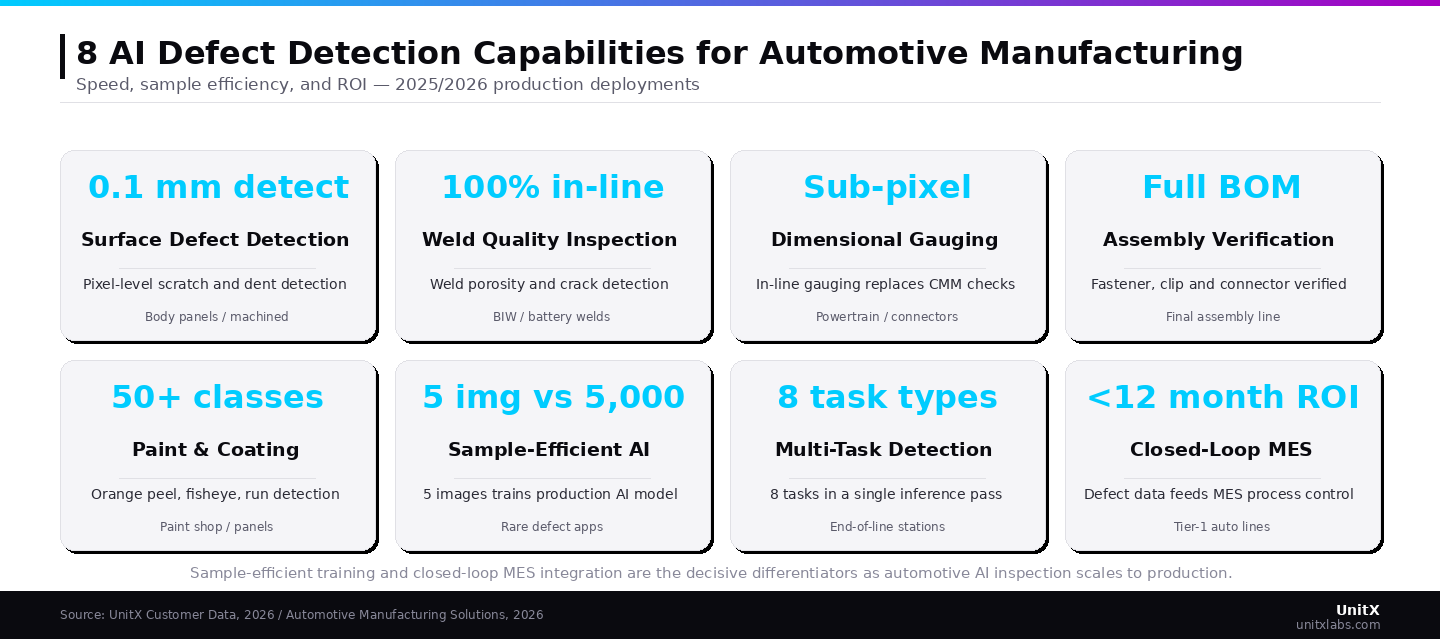
Sample-efficient training and closed-loop MES integration are emerging as key differentiators as automotive AI inspection transitions from pilot to full-scale production.
Evaluation Framework: Selecting AI Defect Detection for Your Automotive Line
Six Criteria Quality Engineers Should Demand
Selecting an AI defect detection system for automotive manufacturing requires evaluation against production realities, not vendor marketing claims. The following six criteria separate systems that perform well in controlled demonstrations from those that sustain performance on actual production floors.
| Evaluation Criterion | What to Demand | Red Flag |
| Sample Efficiency | Production-quality model from ≤10 real defect images per class | Requires 500+ images to start |
| Inference Speed | 100+ MP/s throughput, sub-100ms per part latency | Cloud-dependent inference with network latency |
| Deployment Time | Days to Site Acceptance Testing (SAT), ≤7 days full deployment | 6–12 month deployment timelines |
| False Rejection Rate | FR ≤ 1% — overkill rejection destroys throughput ROI | No FR specification; “high accuracy” only |
| MES Integration | Bidirectional MES/PLC integration for closed-loop control | Export-only reporting with no feedback loop |
| Data Ownership | Edge deployment with full customer data sovereignty | Cloud-mandatory with vendor data access |
ROI Model for Automotive Tier-1 Applications
The automated optical inspection market is growing at 20.6% CAGR as automotive suppliers increasingly quantify inspection ROI in concrete terms. For a high-volume stamped panel line with a 2.8% defect escape rate and a $45,000 per truckload rework cost, reducing escapes to 0.2% can deliver annual savings that exceed the capital cost of most AI inspection systems within the first year. UnitX automotive Tier-1 deployments document approximately $1.3M in annual ROI per production line and payback periods under 12 months for high-variation defect applications (UnitX customer data, 2026).
The ROI calculation changes when false rejection rates are considered. A system that catches all defects but rejects 5% of good parts generates significant false rejection costs — including rework, throughput loss, and inspector review time — that can offset defect escape savings. The target specification is FA = 0% and FR ≤ 1%. Systems that optimize only for detection rate without controlling false rejection are inappropriate for high-volume automotive lines.
Talk to a UnitX expert about building the full ROI model for your application before committing to a system selection.
Frequently Asked Questions
What is the difference between AI defect detection and traditional automated optical inspection in automotive manufacturing?
Traditional automated optical inspection relies on rule-based thresholds: engineers manually define what constitutes a defect based on pixel intensity, dimensional, or shape parameters. This approach requires weeks of setup per part type and breaks down when defect types vary, new defects appear, or part batches shift in surface characteristics.
AI-powered defect detection uses deep learning to learn defect patterns from labeled examples, generalizing to new instances without rule reprogramming. The practical differences include deployment speed (days versus months), adaptability to new defect types, and consistent performance across mixed-model variants that challenge rule-based systems.
How many defect images are needed to train an effective automotive AI inspection model?
The answer varies significantly by system architecture. Traditional deep learning approaches often require 500–5,000 labeled images per defect category, which is impractical in automotive manufacturing where defects are rare.
Sample-efficient AI inspection systems, built on purpose-designed architectures, can achieve production-ready accuracy from as few as 5 labeled images per defect class. FleX-Gen extends this further by generating synthetic defect images from as few as 3 real defect samples, enabling model training from minimal production data. The difference between 5 and 500 image translates directly into weeks versus months of deployment time — a critical competitive factor in new model launch timelines.
What is an acceptable false rejection rate for automotive in-line AI inspection?
The standard specification is FR ≤ 1% for general automotive inspection and FR ≤ 5% for applications where false rejects are recoverable through downstream re-inspection. The false acceptance rate should target 0%, as a defective part that escapes inspection creates downstream costs that far exceed the cost of catching it in-line.
When evaluating AI inspection vendors, require FR and FA specifications based on your specific part geometry and defect classes, not generic accuracy claims. Vendors who cannot provide application-specific FR/FA specifications may lack sufficient production deployment experience for automotive quality standards.
Can AI inspection systems handle the variant complexity of mixed-model automotive production?
Yes — but only if the AI model is trained on sufficient variant coverage and the imaging system provides consistent illumination across that range. The primary challenge is model generalization: a model trained predominantly on one variant may exhibit higher false rejection rates on less-represented variants.
Mitigation strategies include balanced training data across configurations, software-defined lighting that adapts illumination to part characteristics, and multi-task AI architectures that separate dimensional gauging from surface defect classification — allowing each task to generalize independently. UnitX solutions are deployed across multiple automotive Tier-1 suppliers on mixed-model production lines, including powertrain, battery, and body component applications.
What IATF 16949 considerations apply to AI inspection system deployment?
IATF 16949 requires documented measurement system analysis (MSA), including gauge repeatability and reproducibility (GR&R) studies, for all inspection systems used to make pass/fail decisions. AI inspection systems must demonstrate GR&R below 10% for critical characteristics through structured validation.
Research published in Sensors indicates that machine learning-based inspection enables on-time part evaluation while improving early defect detection in highly automated environments — supporting IATF validation for AI-based systems.
To comply, document validation protocols, maintain inspection system performance records, and ensure the AI system produces auditable reject decision logs traceable to individual part and timestamp.