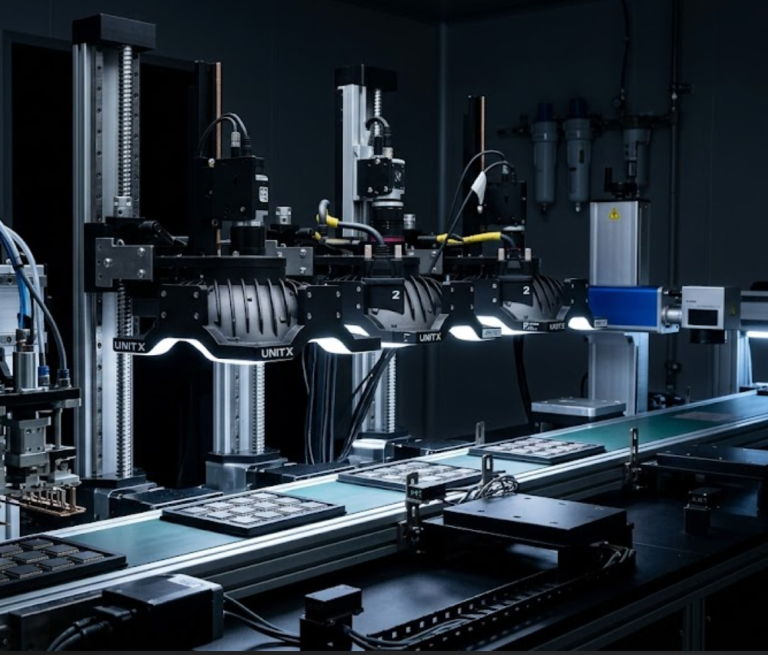
Micro-cracks are among the most consequential and hardest-to-detect defect types in automotive manufacturing. A 0.1mm hairline crack in a forged gear tooth, cast engine bracket, or stamped suspension component may be invisible under standard inspection lighting. Yet under cyclic loading in service, that crack can propagate and lead to failure.
According to a 2025 industry analysis, 72% of manufacturers now use AI vision systems for inspection. However, micro-crack detection remains one of the most technically demanding applications because it requires sub-pixel imaging precision, optimized illumination geometry, and AI models capable of pixel-level defect segmentation rather than simple classification.
This guide covers the five technical requirements for reliable micro-crack detection in automotive production, the imaging and AI configuration decisions that determine detection performance, and how to validate whether a deployed system is actually detecting the types of cracks produced in your process.
Key Takeaways
- Micro-crack detection requires darkfield illumination — brightfield illumination cannot generate sufficient contrast on low-relief surface cracks, regardless of camera resolution.
- Pixel-level deep learning segmentation outperforms traditional bounding-box detection for crack applications because crack geometry is irregular and varies in orientation.
- Fly-capture speed of up to 1 m/s enables in-line crack detection without stop-motion staging on high-throughput automotive lines running 1,200+ parts per hour.
- Sample-efficient AI reduces data collection time from months to days: a system capable of training from 5 labeled crack images per category can achieve production-level accuracy within a 7-day deployment cycle.
- Closed-loop PLC integration bridges the gap between detection and quality action — without it, detected cracks generate data but do not trigger reject mechanisms or real-time production alerts.
- Manual inspection catches roughly 80% of defects at best (Sandia National Laboratories, 2018), with accuracy degrading further during repetitive tasks. As a result, micro-crack detection remains one of the highest-ROI applications for AI-powered inspection systems.
Why Micro-Cracks Are the Hardest Automotive Defects to Detect
The Physics of Crack Visibility
A micro-crack in a machined metal surface is typically 0.05–0.5mm in length, with a depth-to-width ratio that makes it nearly invisible under direct illumination. Specular (mirror-like) metallic surfaces reflect light so strongly that crack apertures — which scatter rather than reflect light — produce minimal contrast under standard brightfield or ring-light illumination.
This is why rule-based machine vision systems struggle with micro-crack detection: the contrast generated by the crack under typical illumination conditions is often insufficient to distinguish it from surface texture noise, tool marks, or material grain boundaries.
Published research on deep learning for automotive defect detection confirms this challenge. A University of Guelph study on automotive gear teeth inspection (NCBI, 2021) found that human-only inspection at a gear manufacturing facility suffered from poor scalability and systematic defect misses due to the volume of components and the variety of defects. These same limitations constrain visual inspection of micro-cracks across automotive sub-assemblies.
Why Rule-Based Systems Fail on Micro-Cracks
Traditional machine vision relies on programmed thresholds — a pixel intensity difference exceeding a defined value constitutes a defect. For micro-crack detection, this approach fails on two counts.
First, crack contrast under consistent illumination is borderline: the threshold that catches all cracks also flags normal surface texture, producing unacceptable false rejection rates. Second, micro-cracks vary in orientation, width, and depth across production batches — a threshold calibrated for one crack morphology misses cracks that present differently. A comprehensive survey of deep learning for defect detection (PMC, 2021) found that machine learning methods, particularly deep learning, now dominate industrial crack detection applications — replacing rule-based approaches that previously required extensive manual threshold calibration for every defect variant.
The Five Technical Requirements for Reliable Micro-Crack Detection
1. Darkfield Illumination: The Non-Negotiable Starting Point
Darkfield illumination positions the light source at a very low angle relative to the part surface (typically below 15 degrees). Under specular reflection, this low-angle light reflects away from the camera. However, the edges and interior surfaces of a micro-crack scatter the incident light in multiple directions — including directly toward the camera sensor. The crack appears bright against a dark background: creating the contrast conditions that maximize AI model detection accuracy.
For polished metal components — including forged shafts, machined gear blanks, stamped body panels, and cast housings — darkfield illumination is not simply one option among several. It is the only illumination geometry that consistently renders micro-cracks with sufficient contrast for reliable detection. Systems attempting micro-crack detection under brightfield or dome illumination on these materials are systematically undertooled for the application.
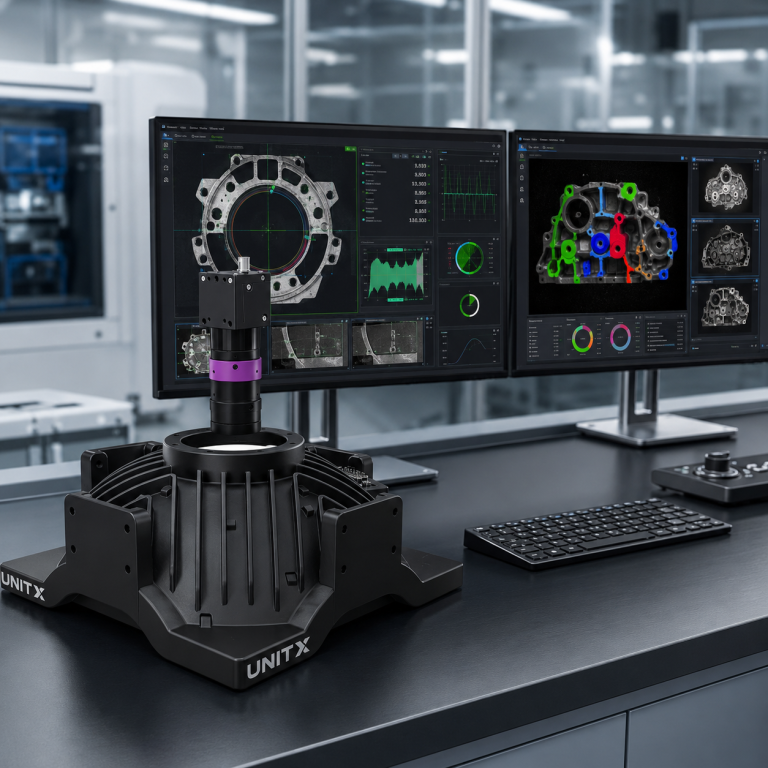
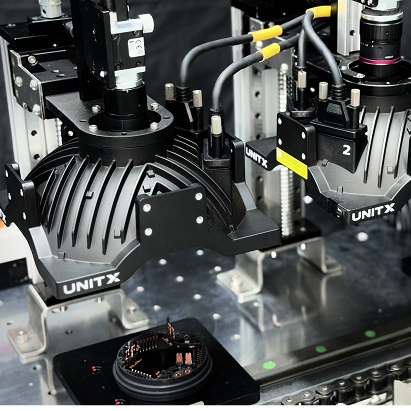
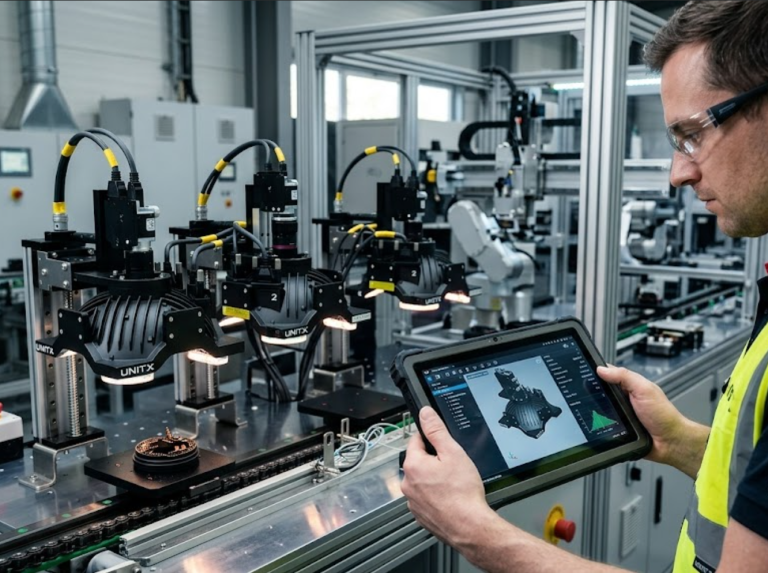
The UnitX OptiX imaging system achieves this through 32-channel software-defined illumination capable of generating darkfield patterns across 50 lighting modes per second, adapting to material and part geometry variations without manual reconfiguration.
2. Pixel-Level Deep Learning Segmentation
Bounding-box object detection — the standard approach in standard computer vision defect applications — draws a rectangle around a detected anomaly and classifies it as defective or acceptable. For micro-crack detection, this approach is insufficient. Cracks are essentially one-dimensional features: their width may be sub-pixel while their length may extend several millimeters. A bounding box often includes both the crack and surrounding material, providing the AI model with insufficient geometric information to distinguish a real crack from a surface mark or scratch.
Pixel-level deep learning segmentation assigns a defect classification to each individual pixel in the image, enabling the system to map the exact path, width, and termination points of a crack. UnitX CorteX’s AI inference system implements this capability through a deep learning segmentation architecture that provides not only defect detection, but also dimensional characterization, including crack length, orientation, and proximity to part edges or stress concentration zones. For safety-critical automotive components such as drive shafts, suspension links, and brake calipers, this geometric data is required for severity grading and compliance with customer traceability standards.
3. Fly Capture Speed Matched to Line Throughput
Micro-crack inspection at a stop-motion station introduces a cycle-time bottleneck on high-throughput automotive production lines. For example, if a production line runs at 1,200 parts per hour, an inspection station requiring 200 ms of stop-motion time per part adds approximately 67 seconds of cycle time per 200 parts — effectively reducing line throughput by 15%.
Fly-capture inspection eliminates this bottleneck by capturing sharp images while parts remain in continuous motion. At fly-capture speeds of up to 1 m/s, the inspection station adds zero cycle time to lines with part transit speeds at or below this threshold. This requires LED strobe timing synchronized with part encoder position to freeze apparent motion during image, capture along with illumination intensity sufficient for exposure times below 1 millisecond. OptiX achieves 1 m/s fly capture with illumination 3X brighter than conventional fixed lighting, enabling short enough exposure times to eliminate motion blur on fast-moving parts without sacrificing darkfield contrast.
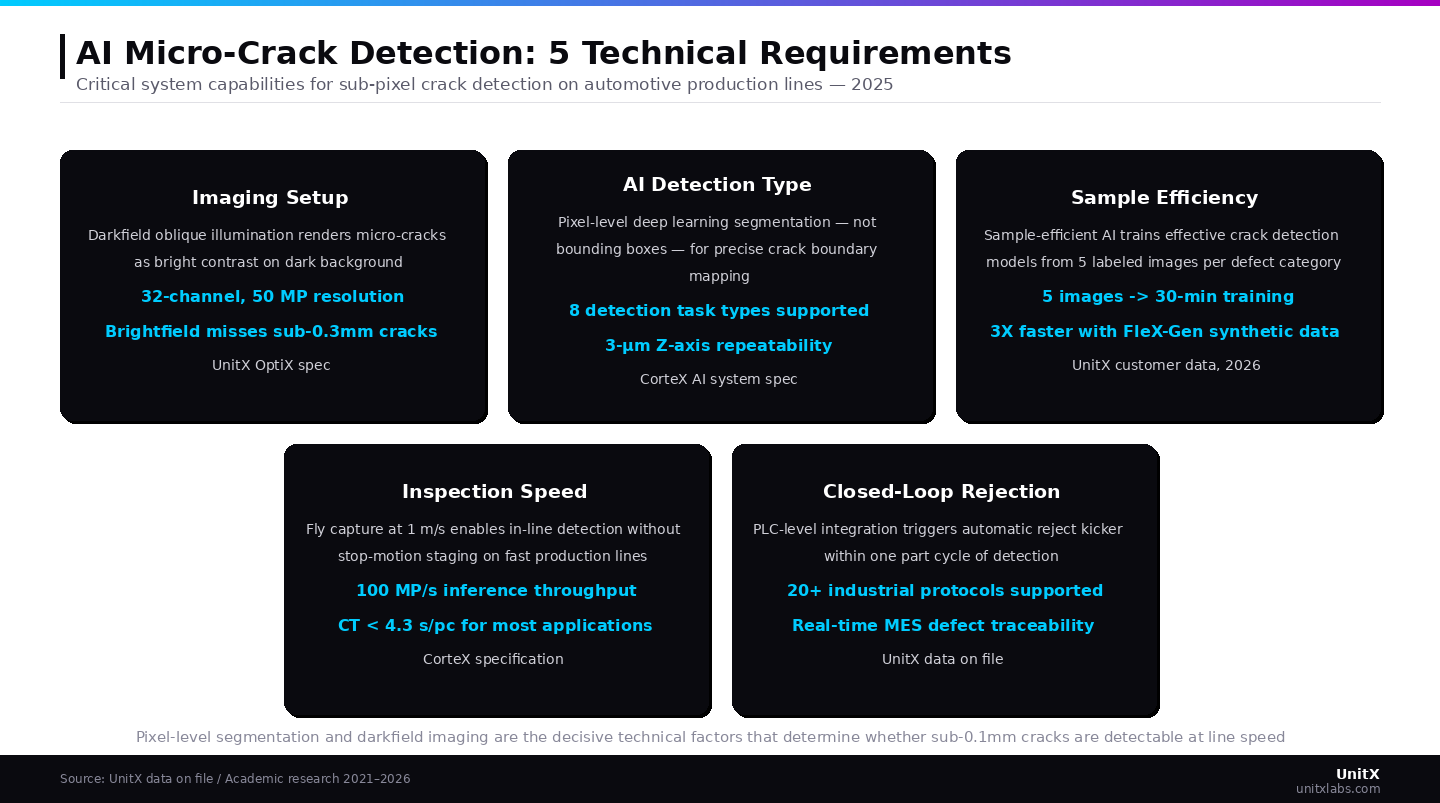
Pixel-level segmentation and darkfield imaging are the decisive factors for sub-0.1mm crack detection at production-line speed
4. Sample-Efficient AI Training for Rare Crack Variants
Micro-cracks are, by definition, rare defects. A manufacturing process with a 0.1% micro-crack rate produces only one cracked part per 1,000 cycles. Waiting to accumulate 500 real crack examples for AI model training — the requirement for conventional deep learning — approximately 500,000 production cycles, potentially taking months.
Sample-efficient AI inspection systems fundamentally change this requirement. According to UnitX’s production deployment data, CorteX can train effective defect detection models from 5 labeled images per defect category. FleX-Gen synthetic data generation further reduces this requirement to 3 real crack samples.
This level of sample efficiency enables a 7-day site acceptance testing timeline for micro-crack inspection applications — a deployment speed that conventional AI inspection platforms typically cannot achieve.
5. Closed-Loop PLC Integration for Real-Time Rejection
Detecting a micro-crack is necessary, but not sufficient for quality control. The inspection result must trigger an immediate physical action — such as activating a reject kicker, stopping a conveyor, or illuminating an operator alert — within the travel time between the inspection station and the rejection point.
On a production line moving at 300 mm/s with a 500mm station-to-reject-point distance, the entire inspection-to-rejection cycle must complete within 1.67 seconds. PLC-level integration — where the AI inference system writes directly to the PLC output register — achieves this within milliseconds. By contrast, higher-level integrations (sending data to MES and SCADA layers before reaching the PLC) can introduce enough latency to miss the rejection window on high-speed lines. The standard to evaluate: closed-loop PLC integration with sub-100ms detection-to-trigger latency, plus real-time defect image and classification data written to the MES for traceability. UnitX supports more than 20 industrial protocols for direct PLC integration, enabling no-code connection to the rejection hardware without custom software development.
Automotive Components Where Micro-Crack Detection Is Most Critical
| Component Type | Critical Crack Location | Consequence of Escape | Recommended Detection Approach |
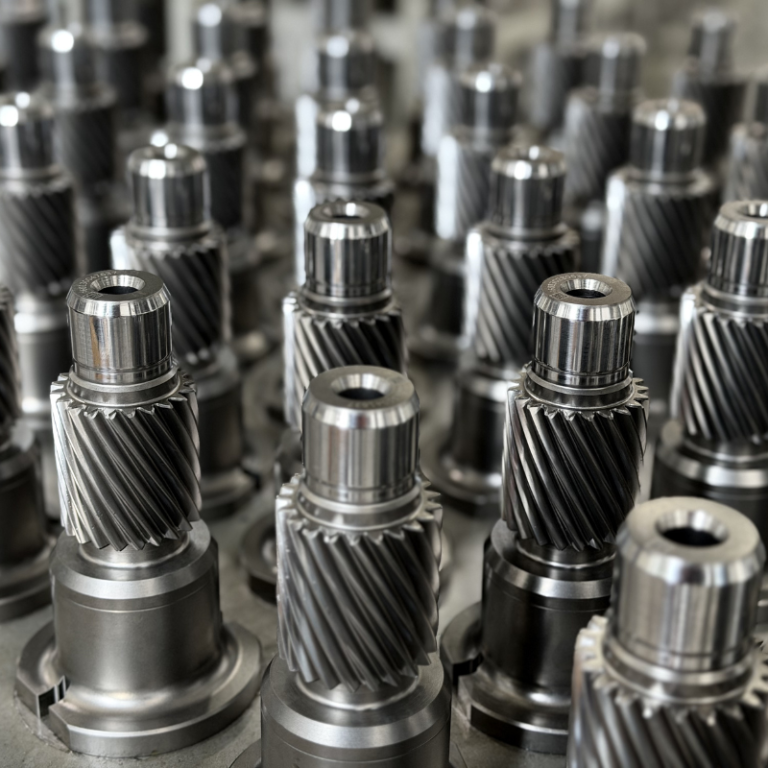
| Gear teeth (transmission) | Root fillet, tooth flank | Catastrophic tooth fracture under cyclic load | Darkfield + pixel-level segmentation at 50 MP |
| Forged connecting rods | Big-end bore, shank radius | Engine rod failure, warranty recall | Multi-angle darkfield, 2.5D depth profiling |
| Stamped body panels | Draw radii, trimmed edges | Paint adhesion failure, corrosion, customer rejection | Fly capture darkfield at full line speed |
| Cast aluminum housings | Wall sections, mounting bosses | Structural failure, fluid leakage under pressure | Structured light + darkfield multi-mode composite |
| Brake calipers / rotors | Caliper bore, rotor hat section | Safety-critical failure, regulatory recall | 100% in-line AI inspection, zero FA target |
The UnitX automotive inspection solution has been production-validated across gear machining, stator core, and body panel applications — component families that span the full range of micro-crack detection requirements in the table above. For a more comprehensive view of application coverage, the gear machining inspection application page documents the specific defect categories detected and the cycle-time performance on production lines.
Validating Micro-Crack Detection Performance Before Going Live
The Minimum Acceptable Validation Protocol
A micro-crack detection system should be validated against a golden sample set — a curated collection of confirmed cracked and confirmed clean parts representing the actual defect spectrum produced by your process. This golden sample set should include: the smallest cracks your quality standards require to detect (i.e., the minimum detectable crack size), cracks in the orientations and locations where they occur on your specific component geometry, borderline cases where crack size approaches the detection threshold, and clean parts that exhibit surface features that may be confused with cracks (such as tool marks, material grain boundaries, or surface texture). The system must achieve FA = 0% (zero crack escapes) on the golden sample set to be accepted into production, with FR ≤ 1% on clean parts to avoid excessive false rejection rates. The 2025 Visual AI Manufacturing landscape report identifies model explainability — the ability to understand why a system makes a specific detection decision — as a key factor in building quality engineer trust in AI inspection deployments, particularly in safety-critical applications.
The Impact of Getting It Right
Micro-crack detection is one of the highest-ROI applications for AI inspection, precisely because the cost of a crack escape is disproportionately higher than the cost of in-line detection. The repair cost ratio between in-line detection and post-delivery remediation for safety-critical automotive components typically exceeds 10:1 when warranty claims, field service, and recall risk are included. Human inspection accuracy degrades by 20–30% after just one hour of continuous monitoring — and micro-crack detection is particularly susceptible to human fatigue because these defects are subtle in appearance under standard lighting.
AI-powered in-line inspection maintains FA = 0% performance across all shifts without fatigue, delivering the consistent quality gate that safety-critical automotive supply chains require. UnitX deployments in automotive applications have demonstrated up to 9X reduction in defect escapes compared to manual inspection (UnitX customer data, 2026).
Frequently Asked Questions
What is the minimum crack size that AI inspection can reliably detect?
With darkfield illumination and 50 MP imaging, AI inspection systems operating at production-line distances can reliably detect cracks with widths down to approximately 0.05mm (50 microns) and lengths above 0.2mm. Detection reliability below this threshold depends on imaging distance, part surface finish, and crack aperture. For applications requiring detection of cracks below 50 microns, close-up inspection stations with higher-magnification optics or structured-light 3D profiling may be required. Contact a UnitX expert to evaluate minimum detectable crack specifications for your specific component geometry and material.
Can AI inspection detect subsurface micro-cracks that don’t reach the surface?
Standard optical AI inspection detects only surface-accessible defects — cracks that open to the part surface and scatter light under darkfield illumination. Subsurface cracks that are fully enclosed within the material cannot be detected by optical inspection methods. For these cases, non-destructive testing methods such as eddy current, magnetic particle, or ultrasonic inspection are required. In practice, most micro-cracks that originate below the surface eventually propagate outward du to manufacturing stresses — making surface inspection an effective quality gate for in-line control in high-volume automotive production.
How many defect samples do I need to train a micro-crack AI model?
With sample-efficient AI and generated defect images, a micro-crack detection model can be trained using as few as 5 real crack images per category within CorteX’s architecture — with FleX-Gen reducing this to 3 real samples through generated images. This is the production-validated minimum for UnitX deployments. Traditional deep learning approaches typically require 500–5,000 labeled images per defect category, making rare-defect applications like micro-crack detection impractical without months of data collection.